Alliance for Democracy

​

​
  • Home
  • About Us
    • National Council and staff
    • Founder, Ronnie Dugger
  • Campaigns
    • Disarming Violence
    • System Change Initiatives
    • Public Banking >
      • Article: Money and Democracy
  • Media
    • Corporations and Democracy >
      • Archives
    • Justice Rising
    • Populist Dialogues >
      • Broadcast in your city
    • In the News
  • Blog
  • Contact
  • Support Our Work
  • DisarmingViolence
  • antiauthoritarianreadings
  • New Page

End of year update and plans for 2026, with your support!

12/30/2025

0 Comments

 
Whether you call it a kleptocracy, an oligarchy, or outright fascism, our country is in serious trouble—trouble that has been brewing for decades. Ronnie Dugger called it back in 1995:
 
The big corporations and the centimillionaires and billionaires have taken daily control of our work, our pay, our housing, our health, our pension funds, our bank and saving deposits, our public lands, our airwaves, our elections and our very government. It's as if American democracy has been bombed.
 
Ronnie’s charge against corporate rule led to the creation of the Alliance for Democracy. Next year marks 30 years of our work “to create true democracy, to end corporate domination of politics, economics, and media, and to build a just and sustainable society for nature and all people.” We’ve organized at every level of government and across diverse issues, from campaign finance to anti-militarism, public banking to food sovereignty, and protection of water to the rights of nature. 
 
While we are celebrating this year’s work, we must build our resistance to the looming threat of fascism in the coming year.
 
We are grateful for your activist and member support. Now we hope you’ll step up again. Renew your Alliance membership or make an extra donation and keep us organizing, educating, and resisting!
 
The Portland OR Alliance chapter has organized locally against military spending and, most recently, against the real threat of attack on Venezuela. They have held regular standouts to draw attention to the human cost of the war budget—$900 million just passed by the House. Chapter president and Alliance co-chair David Delk has connected with other organizations, speaking on the military industrial complex’s threat to democracy and the need for voters to demand Congress members cut war spending and support anti-war legislation. 
 
In 2026, the Portland chapter will kick off a new campaign: a CEO Tax for Oregon. A CEO tax is a surcharge on a corporation’s state taxes determined by the gap between CEO pay and median worker pay. The higher the pay gap, the higher the tax. According to the AFL-CIO Executive Payroll Watch, the average S&P 500 executive made an eye-popping 285 times more than their median worker. The city of Portland already has a CEO tax, and the Alliance will take that model to the state. With Trump’s federal program cuts, the extra revenue is definitely needed. But more importantly, the CEO Tax discourages huge pay gaps between executives and the workers who really make a company profitable, especially if an ever-growing number of cities, counties and states enact similar surcharges. See this fact sheet and join the movement!
 
In Massachusetts, activists are taking on Wall Street by campaigning to create a state public bank. Under Alliance sponsorship and leadership, the campaign has bills in the House and Senate to create the Massachusetts Public Bank. This would be the first public bank to be created since the Bank of North Dakota was formed more than a century ago. The campaign’s steering committee includes Alliance council member Ruth Caplan and national programs coordinator Barbara Clancy, as well as experts on banking, law, and community development. In the coming year, the campaign will focus on coalition-building to advance the bill from the grassroots to the State House. 
 
In Fort Bragg, CA, the Alliance-sponsored GrassRoots Institute features a decentralized and democratic organizing structure, where working groups tackle issues from democracy-building to habitat restoration. This year, the Institute’s Noyo Headlands Working Group won a California state grant for community education focusing on the former Georgia Pacific Mill Site, an industrial site abandoned 23 years ago. Thanks to local organizing the site is now being cleaned up. Another working group has hosted democracy workshops and a Democracy Potluck, attended by more than 100 residents. Their next step is to develop a local political agenda for the common good in coalition with other area groups.
 
On air, “Corporations and Democracy” will continue to bring progressive voices to the airwaves and the internet. This year’s guests included Greg Palast on voter suppression, Jon Bauman on Trump administration attacks on Social Security and Medicare, author/activist Norman Solomon on the state of the nation, and more. The 2026 lineup will be just as dynamic. Get notified of upcoming shows by subscribing to our email list or by following us on Facebook and Bluesky (@endcorprule).
 
And we have new issues planned for Justice Rising. The first will be an online series of articles on fascism versus democracy: what we can learn from history, how to protect institutions and federal agencies under attack, and ways to build local resistance. Then look for a series on our food system focusing on industrial farming and food versus regenerative agriculture, biodiversity and healthy soil, and distribution focused on health and equity rather than corporate profit.
 
Even under the threat of fascism, we are determined to keep pushing back on corporate rule. But we need your support! You can donate through this site, or mail your donation to Alliance for Democracy, 21 Main Street Suite 4, Hudson MA 01749.
 
Keep us standing out, speaking out, and reaching out. Keep our email alerts coming to your inbox, Justice Rising to your mailbox, and “Corporations and Democracy” online and on the air. Your generous end of year donation means more grassroots defiance in 2026!
0 Comments

Call Congress to demand emergency funding for SNAP and WIC programs

10/29/2025

0 Comments

 
Since 1961, the Supplemental Nutrition Assistance Program (SNAP)—formerly known as food stamps—has provided vital financial help to food-insecure households. Administered by the USDA, it is the nation’s largest nutrition assistance program. But the ongoing government shutdown is making it increasingly likely that starting next week, benefits will stop for more than 42 million Americans, half of them children, who depend on SNAP to help stay fed and healthy. 

Please call your members of Congress and demand that a spending bill is passed immediately to protect both the SNAP program, and the WIC program—aka the Special Supplemental Nutrition program, which is only funded through December. Find contact info for your Senators here. Find contact info for your Representative here.  (And you have these numbers in your phone contacts down by now!)

Some states have stopped accepting new SNAP applications in anticipation of the November cutoff. Others are scrambling to allocate state funds to food pantries to help them prepare for increased demand—at a time when federal funding for food banks has also been cut to provide trillions in tax breaks to the rich and when billions of dollars are allocated to our bloated military budget. 

It’s imperative that Congress pass a spending bill or temporary funding measure to ensure that there is no disruption to the SNAP program. Is it possible? Of course—the Republicans hold majorities in both houses and could pass a bill. Sen. Josh Hawley has filed Senate legislation to do just this. 
​
It’s possible that we will have bipartisan agreement that letting 42 million people go hungry is a bad look for the so-called “richest country in the world.” But not without an outcry from voters. Please call today!
0 Comments

The latest from Project HERE

4/28/2025

0 Comments

 
We're happy to share this press release from Project HERE, a project of a subcommittee of the Noyo Headlands Working group of the GrassRoots Institute, an Alliance-sponsored project. 

The Headlands Environmental Remediation Education Project (called "Project HERE" for short) is pleased to announce that we have been awarded a Technical Assistance Grant from the California Department of Toxic Substances Control (DTSC), to engage in community education around the condition of and environmental issues on the former Georgia Pacific Mill Site (Mill Site). This funding is part of the Cleanup in Vulnerable Communities Initiative (CVCI), authorized through Senate Bill (SB) 158 in 2021.  Our grant will allow us to hire a Technical Consultant to review and explain the Mill Site investigation and cleanup reports to the community. Over the next 18 months, Project HERE will be hosting open forum meetings to present this information to members of the Fort Bragg community. We invite you to participate meaningfully in the planning for the remaining remediation of the Mill Site.

Mill Site
The Mill Site covers the western third of the City of Fort Bragg, which consists of about 425 acres of land with about 2 miles of ocean frontage. Abandoned when the sawmill closed in 2002, the Mill Site has been sitting empty since then, with the exception of the Coastal Trail. There have been disputes over who is responsible for cleaning up the toxic chemical residues left from sawmill operations.

Who We Are
We are a group of Coastal residents who are deeply concerned with the lack of progress toward the sustainable cleanup of the Mill Site, particularly regarding the constraints caused by remaining contamination on the Mill Site. Our collective aim is to ensure a safe, productive, and inclusive future for this vital community asset. HERE is a project of a subcommittee of the Noyo Headlands Working Group of the Grassroots Institute.

Our Goals
Our primary goals are to provide the public with meaningful and accurate information about the condition of the Mill Site, particularly "Operable Unit E (OU-E)," the central section with the ponds that contain residual contamination preventing the public from future access. We believe that with this information, the community can effectively participate in the planning process as it moves forward. We aim to ensure that the entire community, including those who have been left out of the process previously, can have their voices heard and affect significant decisions regarding the future of the Mill Site.

What You Can Expect to See Over the Next 18 Months
  • Community Public Survey: We will conduct a survey to evaluate public knowledge about the Mill Site and gather feedback regarding its future remediation.
  • Technical Consultant: The grant will allow for hiring a technical consultant. Their role is to review and interpret the Mill Site data and present that information in an accessible way to the community. The technical consultant will facilitate community forum meetings in both English and Spanish, to explain the Mill Site history, remediation efforts and opportunities, exposure potentials and risks associated with residual contaminants, and to answer the community's questions. The technical consultant will provide documents in both English and Spanish.
  • Community Outreach: We will engage with service organizations, religious fellowships, schools, and other community groups to listen and learn about the community's desires for the Mill Site through small open forum meetings.
  • Sampling and Citizen Science Projects: The technical consultant will lead us in sampling and citizen science projects, enabling community members to actively participate in research efforts.
  • Walking Tours: During this period, we will host walking tours for the public along the Coastal Trail, fostering a deeper connection with the Mill Site and its future uses.
  • Large Forums: Following the community outreach, we will organize meetings to present our findings and discuss the next steps as a community.

Technical Consultant
We have retained Farallon Consulting, L.L.C. as our technical consultant, working specifically with Steffany Aguilar, who is a bilingual Professional Geologist (P.G.) with over 9 years of experience conducting environmental assessments, including investigations, site characterizations, remediation activities, and compliance work. In addition, Steffany is an advocate for women in STEM and volunteers in the San Francisco Bay Area for Scientific Adventures for Girls and Oakland Unified School District.

How to Connect and Participate
Community participation is crucial to the success of this project. We encourage everyone to get involved and share their perspectives, ensuring a diverse and inclusive approach to the Mill Site's future. If you are interested in contributing to the future of the Mill Site, please join our efforts and help us make a positive impact on our community. Please reach out to us with questions or concerns at [email protected], and visit us at Project-HERE.org.
0 Comments

note to a constituent

3/13/2025

0 Comments

 
by John Tieman, after Éluard's "Liberty"

on a voter registration application
on a passport
on a newspaper subscription
in the snow
you write your name
 
on enlistment papers
in the forest in the leaves
on a birth certificate
on an agenda on a dais
you write you name
 
in the confessional
on the rising sea
in the solitude
on the border wall
you write your name
 
in your memoir
in Spanish in Yiddish
in the treble clef
with a preamble
you write your name
 
on a copy of the constitution
on the democratic republic
with blood with ash
with petition and protest
you write your name  

John Tieman is a widely published essayist and poet, as well as a city council member in University City, Missouri. Paul Éluard wrote "Liberté" in 1942, during the Nazi occupation of France; it was first published clandestinely, and has inspired choral and symphonic interpretations by Francis Poulenc and the Canadian composer Jacques Hétu.  


0 Comments

Alliance co-chair David Delk to speak on "Threats to Democracy, the Military Industrial Complex and Beyond"

2/11/2025

0 Comments

 
Picture
Democracy is under threat in several ways. Some of those ways are hidden. Others are in plain sight. On Thursday, February 13, join Alliance for Democracy co-chair David Delk in an online discussion of three threats to democracy, and a deep dive into one: the Military-Industrial Complex. He will also look at corrective measures, including ways to combat militarism.

The discussion starts at 5 PM Pacific, 6 PM Mountain, 7 PM Central & 8 PM Eastern. You can register here.

In addition to his work with the national and Portland OR Alliance, David is a long-time Unitarian Universalist Democracy Advocate, centering on campaign finance reform in Oregon. He is also the founder of the Portland Chapter of Move to Amend, and does anti-war work with the Peace & Action Group of the First Unitarian Church. He is also a board member of the Universalists for Just Economic community as an essential member of its Peace Equity and Climate Task Force.

0 Comments

Killing Hope for Global Peace: Corporate Takeover Of US Military And Foreign Policy

5/29/2024

0 Comments

 
There is no place in a democratic society for an opaque government institution, with an unknown budget, operating for the benefit of powerful corporations and beholden to no one except corporate investors.

by Jim Tarbell

In the early 1900s, after corporate money took over our political system, Wall Street corporate
lawyers became the chosen political appointees to run the US State and War Departments and later created the Council on Foreign Relations as a think tank to develop pro-corporate military and foreign policies.

In the second half of the 20th Century, the next generation of Wall Street lawyers developed the Central Intelligence Agency (CIA) to serve the interests of their corporate clients and the multi-national corporate class.

Wall Street corporate lawyers Bill Donovan, Bill Casey and Allen Dulles worked to create the CIA. Donovan ran the World War II Office of Strategic Services (OSS) that morphed into the CIA, along with its staff of scions of American wealth. Casey served as Donovan’s right-hand man at OSS and served as CIA Director from 1981 to 1988. Dulles met Donovan at a Republican gathering of Wall Street lawyers and soon joined the OSS as a flamboyant agent in Switzerland.

After the war, Allen Dulles and his brother John Foster Dulles worked as members of the famously corporate/imperial Sullivan and Cromwell Wall Street legal firm. They carried on that work when President Eisenhower appointed Allen Dulles Director of the CIA, and his brother, John Foster Dulles, Secretary of State in 1953. Together they made the CIA a covert military operation to benefit their corporate clients. 

In 1953, the CIA overthrew the democracy in Iran for the benefit of the investors in British Petroleum. The next year, the CIA ousted the elected Guatemalan President Arbenz to benefit the United Fruit Company. 

As European colonial empires collapsed in the late 1950s, the Belgian corporation Union Miniere, that mined copper and supplied the uranium used in atomic bombs, hired mercenaries to break away the mineral-rich Katanga province from the Congo. Days before John F. Kennedy (JFK) became president, the CIA helped assassinate the Congolese President Patrice Lumumba, who opposed the Union Miniere's efforts in Katanga Province. As the Congo exploded in war, United Nations Secretary General Dag Hammarskjöld worked to bring peace to the region, which caused Dulles to say, "Dag is becoming troublesome … and should be removed." In September 1961, Dag Hammarskjöld died in a plane crash blamed on the CIA.

Trying to get control of the CIA, JFK forced Dulles to retire. The new CIA Director, John McCone, famed war profiteer and cofounder of the military industrial giant Bechtel, took oversight of the CIA out of the hands of the corporate lawyers and into the hands of the military-industrial-complex.

Bemoaning his lack of control over the CIA, JFK moved ahead to bring peace to the world. He
started pulling US forces out of Vietnam. He embraced a global peace where all nations “live together in mutual tolerance, submitting their disputes to a just and peaceful settlement.” He built relationships with his political adversaries: Nasser in Egypt; Sukarno in Indonesia; and
Castro in Cuba. He also embraced “general and complete disarmament.”

Many movies and books on the assassination of JFK, implicate the CIA in his murder a few month after he made his Peace for All Time speech at the American University. It leads one to conclude that the murders of Martin Luther King Jr. and Robert F. Kennedy and, who both promoted global peace, may have been at the hands of the CIA. It also leads one to wonder how active the CIA and the military-industrial-complex are in shutting down all current efforts to bring about global peace.

The time has come to clear up all these questions. There is no place in a democratic society for an opaque government institution, with an unknown budget, operating for the benefit of powerful corporations and beholden to no one except corporate investors. We should terminate the CIA, open all its records for public scrutiny and make a place for global peace now!
​
(See Part 1 of this article here.)

0 Comments

​Confronting Authoritarian Take-Over

4/11/2024

0 Comments

 
Nonviolent movements succeeded twice as often as violent armed movements, against armed
authoritarian regimes.

​by Dave Lewit

The handwriting is on the wall. Centrist President Joe Biden notwithstanding, disaffected millions of Americans seem willing to consider the likes of Donald Trump in the 2024 election. Can pro-democracy Americans prevail?

Harvard political scientists Erica Chenoweth and Zoe Marks are not sure. They want pro-democracy people and sympathizers to be prepared and active. Their 34-page comprehensive, no-nonsense October 2022 report Pro-Democracy Organizing against Autocracy in the United States: A Strategic Assessment & Recommendations is essential and practical. 

Chenoweth is well qualified: she and colleagues studied 323 significant twentieth century (1900-2006) revolutionary movements worldwide, finding that nonviolent movements succeeded twice as often as violent armed movements against armed authoritarian regimes. But supporting authoritarian regimes are “corporations, business and economic elites, media, party officials and staff, civil servants, security personnel, cultural influencers, foundations and philanthropists, religious leaders, organized labor, and other elite and local authoritarians.”

Drawing on their scrutiny of these nonviolent pro-democracy, revolutionary movements,
Chenoweth and Marks prescribe actions in four essential categories:
  • Build and maintain a large-scale, multiracial, cross-class, pro-democratic United Front;
  • Protect, hold, and build local and community power through alternative institutions;
  • Build pressure to induce defections among autocrat loyalists;
  • Strengthen resilience against increased state “security” or paramilitaries.

Wow, a tall order! The authors then go into important details for each action. These are helpful because they can engage the talents and drives of the mere five percent necessary for a winning movement, who otherwise might despair of the complexity of effective organized activity. Broadly, a United Front “will require a general secretariat with a federated structure. . . a resource bank that can fund legal support, strike relief . . . and other support for chapters to organize and mobilize people.” It should “develop intelligence, community power building, scenario planning, communications, education, training, conflict resolution, and diplomacy.”

Where to begin? First may be calling out illegal, mendacious, and antisocial behavior by authorities’ agents. When too many municipal and state institutions become controlled by a system of white-only, law-and-order, elitist officers and their favored institutions, people seek companionate support. Some nonprofit organizations can help, but face-to-face, left/populist, movement groups—anti-corporatist, ecological, localist, anti-racist, police-reforming, anti-sexist, pro-immigrant, anti-war, socialist—may be more amenable to “intersectionality’s” call for collaboration, and form alternative institutions.

As corporate and government institutions depend more and more on digital controls, physical proximity of local people may encourage “economic cooperatives, fresh food provision, public health institutions, mutual aid, community safety, strike funds, and other forms of cooperation that dramatically reduce the reach, impact, and legitimacy of the authoritarian state.” To promote defections they emphasize “mapping” of authoritarians’ structures and networks to identify key persons and links to overlapping neutral or pro-democracy groupings. Partnering with foreign resistance groups can provide moral authority for local movements, partly by engaging certain international agreements.

But Chenoweth and Marks outline so much more than we can discuss here. For the short and longer terms we must survey what resistance structure we have, and quickly build a more deliberate, comprehensive “pro-democracy infrastructure.”

We know that our movement, our United Front, must be nonviolent. Mahatma Gandhi’s nonviolent movement was top-down — personally driven. Politically, it failed. He had heart and drive, but lacked social infrastructure. Martin Luther King had Gandhi’s drive, and engaged existing organizations like churches as rudimentary infrastructure. Chenoweth and Marks offer a spreadsheet with dozens of critical infrastructure elements, but lack participatory fire — drive, staging, and progressive dynamism. A Trumpist president in 2024 may be a slap in the face — a sting for serious infrastructure building.

Dave Lewit is Professor Emeritus and frequent contributor to Justice Rising. He is the Ombudsman of the Alliance for Democracy.
0 Comments

Books for a world without war

4/10/2024

0 Comments

 
by Jim Tarbell and David e. Delk

Establishing peace in a world without war requires building a culture of peace while
implementing public policy to rid the world of war. Paul Chappell and his Peace Literacy
Institute published seven books in their Road to Peace series that establishes a clear, doable
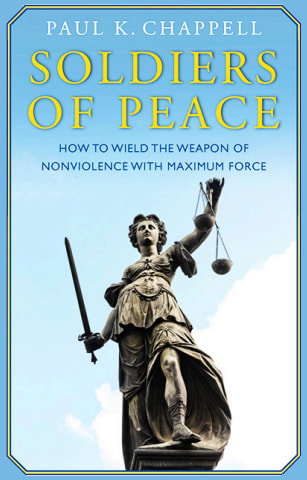
path for establishing a culture of peace. Book five in that series, Soldiers of Peace, will turn us all into non-violent warriors for peace. It builds hope, one of their most important muscles of peace, by outlining the sweeping cultural transformations democracy and education can nourish. Their Peace Literacy program can instigate similar changes to our antiquated acceptance of war as inevitable.

After the horrors of both World Wars, politicians, jurists, scientists and publishers were
all enthusiastic to create both a culture of peace, and public policy to make global peace
a reality. Notables from Albert Einstein to Senator J. W. Fullbright endorsed the rationale
and route to international peace laid out in Emery Reves' 1945, world-wide, best selling book, The Anatomy of Peace. Reves, internationally known author, publisher, and close friend of
Churchill and others, calls out the failures of capitalism, socialism, religion and fascism, along with the evils of nationalism and the nation state system. He then goes on to declare “we can protect ourselves against international wars only through the establishment of constitutional life in world affairs by freely elected and responsible representatives.”

World leaders planned for the United Nations to become such an institution. But the UN bogged down in the “evils of the nationstate system.” It took fifty years for the movement calling for international democratic decision making on global issues to reemerge. Now that idea has been updated in A World Parliament: Governance and Democracy in the 21st
Century
by international parliamentarian Joe Leinen and Democracy Without Borders co-founder and director Andreas Bummel. They point out that the need for a world parliament goes way beyond just international peace. Now we need this international, democratic institution to deal with the climate crisis, migration, depletion of global resources, pollution of the earth, multinational corporate tax evasion, and so many other world-wide problems that the nation-states can not deal with.

Unfortunately, the international peace movement is being stifled by multinational corporations and their allied military-industrial complexes. Joan Roelofs lays out how this
works in her book The Trillion Dollar Silencer: Why there is so little Anti-War Protest in the
United States
. She documents how corporations and their military allies have infiltrated every level of American society with unlimited funds to compromise any movement toward global peace. Then she shows her readers on how to educate themselves and reverse the trend by
hounding their politicians, joining a peace group, creating a peace culture with a national
service organization, and pushing a green New Deal that will convert our war economy into a peace economy.

Medea Benjamin, probably the greatest peace organizer in the United States, and Nicolas
J.S. Davies bring all this together in their seminal book War in Ukraine: Making Sense of a
Senseless Conflict
. While condemning Russia's invasion of Ukraine, they also point out that the West helped cause the conflict by reneging on promises to not expand NATO into Eastern
Europe, before relentlessly pushing NATO bases toward Russia's border. The West's courting of Ukraine aims at completing that process, while ignoring President Kennedy's warning not to corner a nuclear power, leaving nuclear war as its only option, and causing the annihilation of life as we know it.

Meanwhile, Norman Solomon’s new book, War Made Invisible: How America Hides the
Human Toll of Its Military Machine
is a must read. Americans don’t know how the US military dominates America and the world, fighting or inciting endless wars, spending the
American taxpayers tax dollars without being held accountable.

How can the US military and its corporate contractors receive more than half of federal discretionary funds while the American people are kept in the dark, unable to rise up to say “Enough is Enough?” Norman's book shows how the American “free” press hides all
stories, which would inform the American people, and helps explain how and why our
“free” press makes invisible the American military death machine.
0 Comments

Peace Literacy: Moving from a Military Empire To a Culture of Peace

3/1/2024

2 Comments

 
Picture
We can create a culture in a school, workplace, family, community, and society that strengthens Peace Literacy and nurtures the full development of our humanity.

Excerpted from an interview with Paul Chappell, hosted by Zoe Weil for the Institute for Humane Education, April 2022

Peace Literacy offers a deep and accurate understanding of the many subjects relevant to the creation of a more peaceful and just world. Peace Literacy consists of the idea that peace is not merely a goal, but a competency — a literacy — similar to reading and writing, which we can learn to use with greater and greater effectiveness. In the Twenty-First Century, we can no longer settle for peace as an abstract concept or sentimental wish. Peace Literacy is a rigorous and strategic approach to peacemaking that is based on the recognition that we must take waging peace at least as seriously as the military takes waging war.

Peace Literacy consists of three basic elements:

The first is the development of human capacities, which we call the muscles of our humanity. One of these capacities is hope, which is like a muscle, because it requires strengthening and development, and can become more powerful in degrees. Peace Literacy cultivates realistic hope based on evidence, experience, and ideals. Realistic hope is proactive and connected to action.

The muscles of empathy and conscience drastically affect how we think and reason. In Peace Literacy, we say that stewardship is the highest expression of the muscle of appreciation, because appreciation allows us to not take the gifts of life for granted. Gifts such as health, friendship, and democracy are fragile, and can be damaged and destroyed when we are not behaving as responsible stewards and protectors. Appreciation encourages us to never take these gifts for granted, to savor and make the most of them, and to do our best to protect them.

The second element of Peace Literacy is the building of skills to flex the muscles of our humanity. To offer just one example, listening is a skill that requires me to flex my muscle of discipline, to focus my mind and concentrate. In order to truly listen, I must also flex my muscle of empathy. When I flex my muscle of empathy, I am capable of hearing not only your words, but also your humanity.

The third element of Peace Literacy involves increasing the accuracy of our understanding of how the world works. When people with empathy and conscience don’t have an accurate understanding of the root causes of problems, they can cause harm. As the old saying goes, “The road to hell is paved with good intentions.”

Soldiers of peace must understand the tangles of trauma; the root causes of aggression; the
critical importance of our non-physical needs such as purpose, meaning, belonging, and self-worth; the relationship between our human vulnerability and our technology; the behaviors that can reliably build shared trust between individuals, communities, and nations; the limitations and risks of waging war, and the power and potential of waging peace.

The elements of Peace Literacy can be taught in three ways. They can be taught through curriculum, scaffolded in age-appropriate ways for pre-K through adult education. They can be taught through example, when adults lead by example by practicing Peace Literacy. The third way that Peace Literacy elements can be taught is through culture. We can create a culture in a school, workplace, family, community, and society that strengthens Peace Literacy and nurtures the full development of our humanity.

Paul K. Chappell is an American activist. He is the Director of the Peace Literacy Institute. A graduate of West Point and a veteran of the war in Iraq, he created the idea of Peace Literacy after his time in the military.

2 Comments

Building Cultures of Partnership and Peace

2/29/2024

0 Comments

 
Picture
Working together, we can build the foundations for a more peaceful, equitable, sustainable world.

by Riane Eisler
(Excerpted and abridged from The Kosmos Journal, Spring/Summer 2014)

Can we build a more peaceful world where our great human potential for consciousness, caring, and creativity are realized? What would this more equitable, less violent world look like? How can we build it?

To answer these questions, my examination of social systems looks at the whole of humanity, including the thousands of years we call prehistory. This more complete picture makes it possible to see two historical social systems — a domination system and a partnership system.

Until just a few thousand years ago, archeological records show we lived in a partnership system. Archeology shows no signs of warfare; houses and burials do not reflect large gaps between haves and have-nots; and these earlier societies were neither patriarchies nor matriarchies, but cultures where women and men were equally valued in partnership.

However, archeology and myths since that time show a major cultural shift toward the domination system. Fortunately, over the last centuries there has been strong movement to reverse this shift in cultural direction back toward a partnership system.

One modern progressive movement after another has challenged the oppressive features of this dominator system. These include democratic challenges against: the “divinely-ordained” right of despotic kings to rule their “subjects;” the anti-colonial liberation movements that challenged the “divinely-ordained” right of one race or nation to rule over another; the women’s rights movement that has challenged the right of men to rule women and children; all the way to the environmental movement challenging man’s “divinely ordained” right to dominate and conquer nature.

Unfortunately, the focus of these progressive movements toward a more equitable and peaceful society has only been on dismantling the top of the domination pyramid. The primary relations between men and women, and between them and their daughters and sons, on which the pyramid keeps rebuilding itself, has remained largely in place. Since these relationships have been ignored, we lack the solid foundations for a peaceful and caring society.

Moving toward the partnership side of the continuum requires a more democratic organization in both the family and state or tribe, where both halves of humanity are equally valued, and stereotypically feminine values such as caring and nonviolence (which are considered “unmanly” in the domination system) are highly regarded, whether in women or men.

The relationships of women and men shapes families, education, religion, politics, and economics. The social construction of gender roles and relations also shapes a society’s guiding values.

As long as boys and men learn to equate “real masculinity” with violence and control we cannot realistically expect an end to the arms build-ups that are today bankrupting our world, and the terrorism and aggressive warfare that in our age of nuclear and chemical warfare threaten our survival.

A peaceful way of living fosters mutual respect and accountability. It uses power to empower rather than disempower others. The partnership configuration is a blueprint for a more equitable, caring, and peaceful future.

We must show that the struggle for our future is not between religion and secularism, right and left, East and West, or capitalism and socialism, but within all these societies between traditions of domination and a partnership way of life.

Every one of us can play a role in the cultural transformation from domination to partnership. Working together, we can build the foundations for a more peaceful, equitable, sustainable world, where all children can realize their capacities for consciousness, caring, and creativity — the capacities that make us fully human.

Riane Eisler is a social systems scientist, cultural historian, futurist, and attorney whose research, writing, and speaking has transformed the lives of people worldwide. She is president of the Center for Partnership Systems (CPS), and Editor-in-Chief of the Interdisciplinary Journal of Partnership Studies.

graphic: Raj Phairembam

0 Comments
<<Previous

    Archives

    December 2025
    October 2025
    April 2025
    March 2025
    February 2025
    May 2024
    April 2024
    March 2024
    February 2024
    January 2024
    December 2023
    August 2023
    April 2023
    March 2023
    January 2023
    April 2022
    March 2021
    November 2020
    October 2020
    June 2020
    April 2020
    March 2020
    January 2020
    December 2019
    October 2019
    September 2019
    August 2019
    July 2019
    June 2019
    May 2019
    April 2019
    March 2019
    December 2018
    November 2018
    October 2018
    September 2018
    August 2018
    July 2018
    May 2018
    April 2018
    March 2018
    February 2018
    January 2018
    November 2017
    October 2017
    September 2017
    July 2017
    June 2017
    May 2017
    April 2017
    November 2015
    August 2015
    September 2013
    August 2013

    Categories

    All
    Afghanistan
    Boston
    Candidate Questions
    Corporations And Democracy
    Democracy
    Democracy Convention
    Fast Track Authority
    GrassRoots Institute
    Health Care
    Justice Rising
    Local Food
    Militarization
    Money In Politics
    NAFTA
    National Council Actions
    Peace
    Peoples Vote Must Count
    Portland OR
    President Obama
    Public Banking
    Public Health
    Ronnie Dugger
    Solidarity Economics
    System Change Initiatives
    Take Action
    Tpp
    Tpp Free Zone
    Trade Justice
    Washington DC
    Water

    RSS Feed

Powered by Create your own unique website with customizable templates.